
Why I Believe Most SaaS Free Plans Eventually Become a Monetization Problem

June 12, 2026
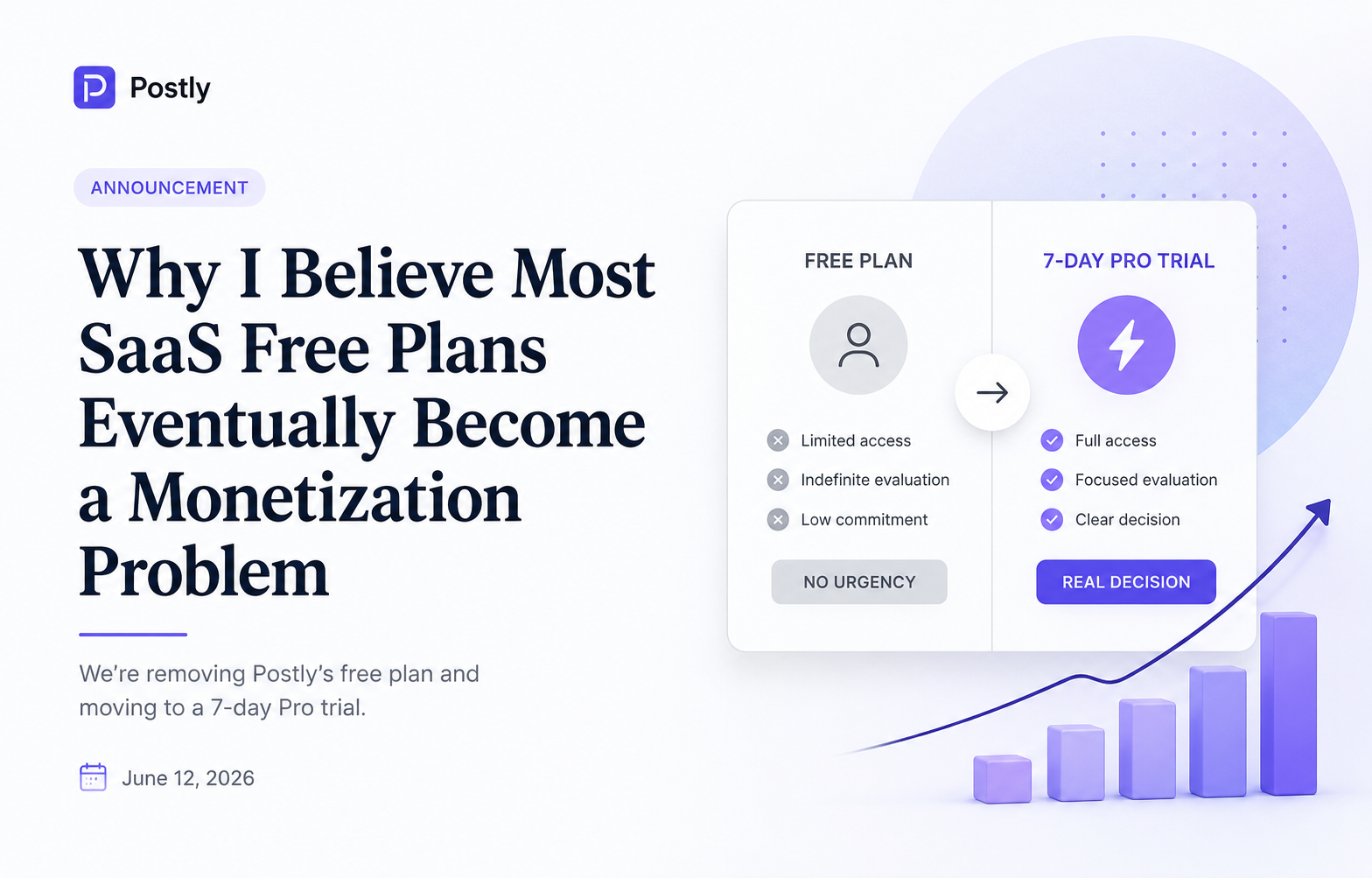
A free plan tells users that they can continue evaluating for as long as they want. A free trial communicates that they have a defined period in which to determine whether the product deserves a place in their workflow. One model optimizes for access. The other optimizes for decision-making.
Today I decided to remove Postly's free plan and replace it with a 7-day Pro trial. While this is one of the largest monetization changes we have made since launching the product, the decision was not driven by slowing growth, declining demand, or some sudden concern about the future of the business. In fact, the more surprising reality is that Postly continues to grow at a healthy pace through organic acquisition, consistently attracting dozens of new users every day without any major investment in paid marketing.
What changed was not the number of people signing up. What changed was how I thought about those signups.
Over the last several months I found myself asking a question that many SaaS founders eventually encounter: if the product is attracting users, why are so many of those users never reaching a meaningful purchasing decision? The deeper I looked into the data and the behavior patterns behind it, the more I began to suspect that the free plan was not helping people move toward a commitment. In many cases, it seemed to be encouraging them to postpone one.
The Difference Between Growth and Business Growth
One of the easiest traps to fall into as a SaaS founder is confusing user growth with business growth. Both metrics feel positive because they move in the same direction, but they often represent very different realities.
When a new user signs up, it creates a small sense of momentum. Dashboards look healthier, account numbers increase, and acquisition channels appear to be working. Yet a signup is ultimately just an expression of curiosity. It tells you that somebody was interested enough to create an account, but it tells you almost nothing about whether they are willing to become a customer.
For a long time, I viewed the free plan as a natural bridge between curiosity and commitment. The assumption was that users would sign up, experience the value of the platform, gradually incorporate it into their workflow, and then upgrade when they reached the limits of the free tier. It is a model that has become deeply embedded in SaaS thinking because it sounds logical and because there are many examples of companies that have used it successfully.
What I gradually realized, however, was that the existence of a free plan does not necessarily move users closer to a buying decision. Sometimes it simply allows them to delay making one.
How Free Plans Can Create Permanent Evaluators
The original purpose of Postly's Starter plan was straightforward. It was designed to reduce friction and make it easier for new users to experience the platform before committing financially. The expectation was that the free plan would act as the beginning of a conversion funnel.
In practice, something more subtle happened.
Many users would create an account, connect social profiles, experiment with AI features, generate a handful of posts, and spend time exploring the platform. They would compare Postly against other products, read documentation, test workflows, and evaluate features. Then they would simply stop.
Not because they disliked the product.
Not because the onboarding experience failed.
Not because the platform lacked value.
Instead, they remained suspended in a state of ongoing evaluation where there was no real pressure to decide whether Postly was worth paying for.
The longer I observed this behavior, the more I came to believe that the free plan was accomplishing two things simultaneously. It was lowering the barrier to entry, which was positive, but it was also lowering the urgency to commit, which was not.
That distinction became increasingly difficult to ignore.
The Market Has Matured More Than Most Founders Realize
I think part of the reason free plans became so popular is that they emerged during a period when many software categories were still educating customers.
When Postly launched, social media automation and AI-assisted content creation were still relatively early in their adoption cycle. Many users genuinely needed time to understand what these tools could do, how they fit into existing workflows, and whether they could deliver meaningful value. In that environment, a free plan served an important purpose because people were evaluating the category itself.
Today's market looks very different.
Most prospective customers already know what a social media scheduler does. They understand content calendars. They understand AI writing tools. They understand automation, publishing workflows, and performance tracking. The average user arriving on Postly's website is not trying to determine whether this category of software is useful.
They have already reached that conclusion.
What they are trying to determine is which vendor deserves their money.
That shift is important because it changes the role a free plan plays in the buying process. If someone is comparing Postly against Buffer, Publer, Vista Social, SocialBee, Metricool, Typefully, or any number of newer AI-first competitors, they are already operating within a purchasing mindset. They are not looking for education. They are looking for confidence.
In that environment, extending the evaluation period indefinitely may not be helping the customer as much as we assume.
Why I Think Trials Create Better Decision-Making
The difference between a free plan and a free trial is often underestimated because, on the surface, both allow users to experience the product before paying.
Psychologically, however, they create entirely different incentives.
A free plan tells users that they can continue evaluating for as long as they want. A free trial communicates that they have a defined period in which to determine whether the product deserves a place in their workflow. One model optimizes for access. The other optimizes for decision-making.
Over time I have become increasingly convinced that the second model is healthier for both the customer and the business.
When users receive full access to a product and understand that a decision must eventually be made, they engage with the software differently. They are more intentional. They test more thoroughly. They explore workflows that matter to them. Most importantly, they begin evaluating the product through the lens that ultimately matters: whether it is worth paying for.
That is the question every SaaS business must eventually answer, and delaying the question rarely makes the answer clearer.
The Simplest Possible Implementation
One principle that has guided many of our product decisions at Postly is that experiments should be easy to understand and easy to reverse.
Because of that, we are not redesigning our pricing structure, creating new subscription tiers, or introducing complicated migration logic. We are simply changing the access model.
If a user has an active subscription, they can use Postly.
If a user has an active trial, they can use Postly.
If they have neither, they are redirected to billing.
By keeping the implementation simple, we gain something valuable: the ability to learn quickly. If the experiment succeeds, we will know why. If it fails, we can reverse it without creating technical debt or operational complexity.
The goal is not to make a dramatic change for the sake of making one. The goal is to test a specific hypothesis with as little noise as possible.
The First User Reaction Captured The Whole Decision
Shortly after the change went live, a user reached out because they could no longer access the dashboard. They had been using the free plan, logged in expecting the same experience they had previously received, and instead found themselves redirected to start a Pro trial before they could continue.
The conversation was short, but it captured the entire decision better than any internal strategy document could have done.
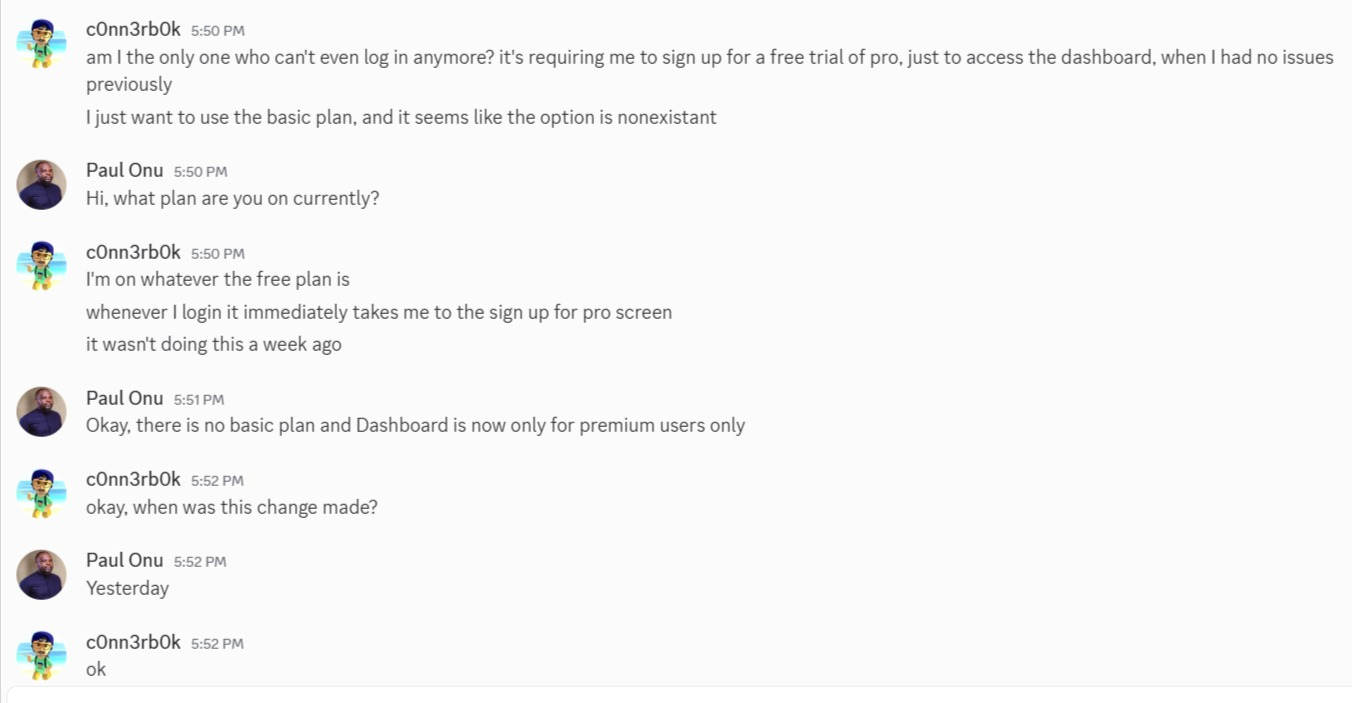
What made the exchange interesting was not that the user was confused. Their confusion was completely reasonable. From their perspective, Postly had a free plan before, they were able to access the dashboard before, and now that access had changed without the product behaving the way they expected it to behave a week earlier.
That is the part founders sometimes underestimate.
When you make a pricing or access decision, you may see it as a monetization strategy, a conversion experiment, a billing architecture change, or a correction to the business model. The user experiences it much more simply. Yesterday they could use the product. Today they cannot, unless they start a trial or pay.
That support conversation made the abstract strategy feel very real.
It also reinforced the exact point behind the decision. The user was not evaluating whether the product category made sense. They were not asking what a scheduler does, or why AI content generation might be useful, or whether Postly could help them manage their social media workflow. They already understood enough to want continued access to the dashboard.
The question was whether that access should remain free indefinitely.
For me, the answer is now no.
Removing a free plan is not just a technical change. It is an expectation change. When people have been allowed to use a product for free, they naturally assume that free access will continue. The moment that changes, every user is forced to make a decision about the product’s value.
Some will decide it is worth paying for.
Some will decide it is not.
That is uncomfortable, but it is also clarifying.
What Success Actually Looks Like
One consequence of this decision is that signup numbers may decrease. In fact, I would not be surprised if they do.
That possibility does not concern me.
The metric I care about most is not how many people create accounts. It is how many people become customers.
If fewer users sign up but a significantly larger percentage convert into paying subscribers, the business becomes healthier. If trials increase, trial-to-paid conversion improves, and monthly recurring revenue grows, then the experiment will have achieved its purpose regardless of what happens to raw signup volume.
Too many SaaS businesses become obsessed with top-of-funnel metrics because they are easy to measure and easy to celebrate. Revenue, however, is ultimately what determines whether a company can continue investing in product development, customer support, infrastructure, and long-term growth.
A business is not validated by attention. It is validated by customers.
My Current View on Free Plans
I do not believe free plans are inherently bad. There are countless examples of companies that have used them effectively, and there are situations where they make perfect sense. Products with strong network effects, collaboration-driven workflows, or extremely large markets can often benefit enormously from a free acquisition strategy.
What I have become skeptical of is the assumption that every SaaS company should have one.
For bootstrapped businesses that already have product-market fit, consistent inbound demand, and a steady flow of qualified users, the bottleneck is often no longer awareness. The bottleneck becomes monetization.
That is the conclusion I have reached with Postly.
The purpose of this change is not to maximize curiosity. It is to maximize commitment. Whether that belief proves correct will become clear over the coming weeks as we collect data and observe user behavior.
For now, however, my working assumption is simple: once a product has established demand, helping users make a decision becomes more valuable than helping them postpone one.