
Nigeria 2027: A Future Hanging in the Balance

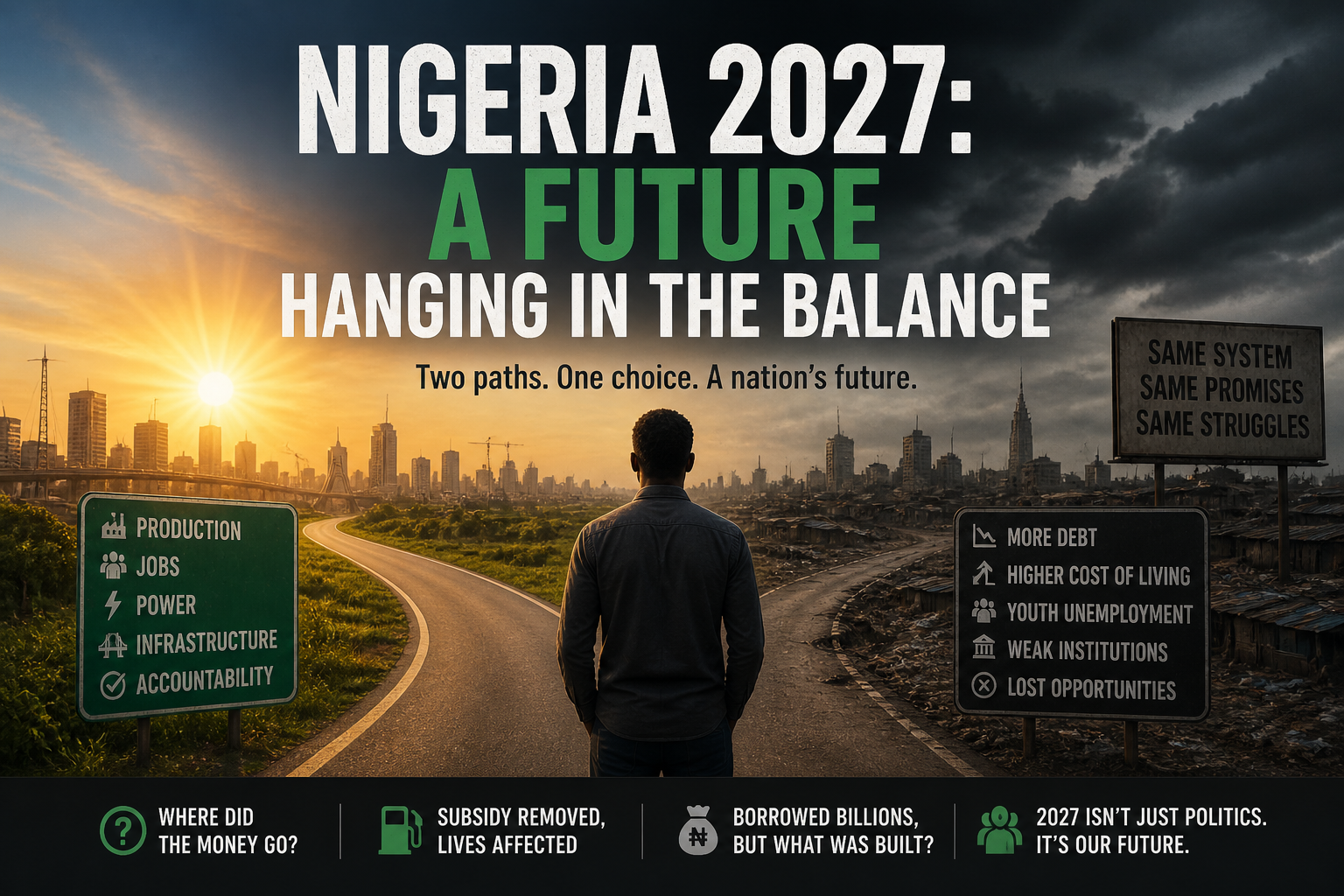
There is a quiet tension in Nigeria today, not loud enough to be called panic, but too persistent to ignore, a collective holding of breath by millions who sense that the next election cycle is not just another political ritual but a defining moment that could either stabilize a fragile system or deepen a long-running decline.
The Numbers Behind the Anxiety
To understand why 2027 feels different, you have to start with the numbers, because beneath the daily noise of politics, the Nigerian economy is sending very clear signals.
As of December 2025, Nigeria’s total public debt stood at approximately ₦159 trillion (about $111 billion), split between domestic and external obligations, with domestic borrowing now slightly higher than foreign debt.
This is not just a large number; it represents a structural shift in how the country finances itself, increasingly borrowing internally and crowding out private-sector credit that would otherwise support production.
At the same time, inflation has remained stubbornly high. The IMF estimated that Nigeria’s inflation averaged around 31% in 2024, driven by currency depreciation, energy price shocks, and supply constraints, before moderating somewhat in 2025.
Yet official numbers only tell part of the story, because for most Nigerians, the real cost of living is defined not by statistical averages but by the daily price of food, transport, and fuel.
Fuel Is the Real Economy
Fuel, in particular, sits at the center of Nigeria’s economic reality. In a country where electricity supply is unreliable, petrol is not just an energy source, it is infrastructure, powering homes, businesses, transport systems, and supply chains.
When fuel prices rise, everything else follows, and when subsidies are removed without corresponding efficiency gains or accountability, the burden shifts almost entirely to citizens.
The result is an economy that, despite signs of macroeconomic stabilization, has not translated progress into improved living standards. The World Bank notes that while Nigeria has made “important steps toward stabilizing its economy,” these gains have yet to meaningfully reduce poverty or improve everyday outcomes.
Growth exists, but it is not inclusive, stability exists, but it is not yet felt.
The Question Nigerians Keep Asking: Where Did the Money Go?
Nigeria has borrowed heavily. Subsidy has been removed. Citizens have been asked to endure short-term pain for long-term gain.
So where is the gain?
On paper, the answer exists. Some loans are tied to development programs. The World Bank approved $2.25 billion in 2024 for economic stabilization and revenue reforms, and another $1.57 billion for health, irrigation, and dam safety projects.Source: World Bankhttps://www.worldbank.org/en/news/press-release/2024/06/13/supporting-nigeria-homegrown-reforms-new-world-bank-financing-for-inclusive-growth-and-revenue-diversificationhttps://www.worldbank.org/en/news/press-release/2024/09/26/world-bank-approves-new-financing-for-nigeria-to-improve-health-outcomes-safety-of-dams-and-irrigation-services
These are real programs with defined objectives.
But citizens do not live on project descriptions.
They live with poor roads, weak hospitals, unreliable power, rising insecurity, expensive fuel, and shrinking purchasing power. When the visible condition of a country does not reflect the scale of its borrowing, distrust becomes rational.
The same applies to subsidy removal. Government revenues increased, and FAAC allocations reportedly rose to about ₦15.26 trillion in 2024, partly due to subsidy removal and exchange rate reforms.Source: NEITIhttps://dateline.ng/faac-allocations-up-by-43-in-2024-neiti/
But increased revenue is not the same as visible progress.
There is no widely trusted, transparent account that clearly shows how subsidy savings have translated into better roads, reliable electricity, affordable transport, or improved public services.
Civil society groups have even demanded explanations for trillions of naira in subsidy savings, highlighting a growing gap between policy decisions and public trust.Source: SERAPhttps://serap-nigeria.org/2025/10/05/account-for-n14trn-fuel-subsidy-savings-or-face-legal-action-serap-tells-36-governors-wike/
This is where the problem becomes deeper than policy.
The Loop of Doom
Nigeria is caught in a cycle that is difficult to break.
The government borrows to sustain itself.It removes subsidy to increase revenue.Citizens absorb higher costs.Public services do not significantly improve.Productivity remains weak.And then the government borrows again.
Because the core issue is not simply debt or inflation, it is that the system does not consistently convert sacrifice into visible progress.
A Structurally Unproductive Economy
This gap between policy and lived reality is where the deeper issue lies.
Nigeria is not simply struggling because it is poor, it is struggling because it remains structurally unproductive. The economy still relies heavily on exporting raw commodities and importing finished goods, while domestic manufacturing, refining capacity, and energy infrastructure lag behind.
Even when reforms are introduced, whether in exchange rate management or subsidy removal, they often operate within a system where leakage, inefficiency, and weak institutions dilute their impact.
This is what many observers describe as a form of state capture, not necessarily in a dramatic sense, but in the quieter reality that key systems such as revenue collection and public spending do not consistently function in the public interest.
When interest payments alone consume a large share of government revenue, fiscal space shrinks, and the state becomes less capable of investing in long-term productivity.
Why 2027 Feels Different
Against this backdrop, the anxiety around 2027 begins to make sense.
For many Nigerians, the election represents a narrow window for change, a chance, perhaps the last in a generation, to shift the country from a consumption-driven, debt-dependent model toward one built on production, infrastructure, and institutional credibility.
There is a belief, especially among younger and urban populations, that a different kind of leadership could begin this transition, however gradually.
At the same time, there is an equally strong fear that this moment could be missed.
Two Futures, One Uncertain Path
If the current trajectory continues without structural reform, Nigeria is likely to remain politically functional but economically strained, with rising costs of living, and increased reliance on private substitutes for public goods.
Growth may persist, but at a pace too slow to materially improve per capita outcomes, reinforcing a cycle where more citizens depend on informal systems, remittances, or survival strategies rather than formal economic participation.
Yet the opposite scenario is not without uncertainty either.
Even if a reform-oriented leadership emerges, it would inherit a system constrained by debt obligations, entrenched interests, weak institutions, and global economic pressures.
Reform, in this context, is not simply a matter of policy intention, it is a process of negotiation with existing power structures, both domestic and international.
This is the tension that defines Nigeria’s present moment, not the absence of hope, but the fragility of it.
A Country Holding Its Breath
Because Nigeria is not without potential. It remains one of the largest economies in Africa, with a young population, a growing technology sector, vast agricultural capacity, and significant natural resources.
But potential alone does not determine outcomes, systems do.
And unless the underlying structure shifts toward reliable power, efficient revenue management, stronger institutions, and a deliberate focus on production, the gap between what Nigeria could be and what it is will continue to widen.
This is why 2027 feels different. Not because it guarantees change, but because it represents a moment where change is still possible, and where the cost of missing that moment is becoming harder to ignore.
For now, the country waits, watching, debating, preparing, caught between a future that could stabilize and one that could stall, holding its breath for an outcome that, either way, will shape Nigeria for years to come.