Founder Lessons Start a Business Post With a Customer Question A practical way to make business content useful: answer one customer question, give an example and offer one next step.
Founder Lessons A Better Growth Channel May Be the Workflow Your Audience Already Uses A practical growth lesson from Postly’s AI-agent work: distribution succeeds when a new workflow helps people reach a first useful outcome.
Product Building Making Postly’s Connected Accounts Easier to Manage Postly’s connected account views and selection controls are being refined to help people manage growing channel sets.
Product Building Building Postly: What a Green Connection Badge Should Promise A small connection-status correction in Postly prompted a useful question: what will someone reasonably believe after reading this badge?
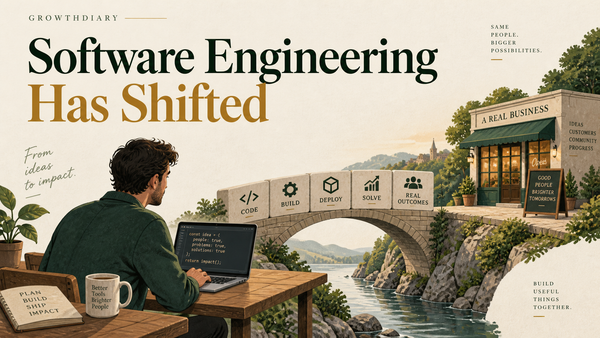
Artificial Intelligence Software Engineering Has Shifted. The Opportunity Is Bigger Than Code. From my early days writing Java to building Postly and AskOnu: how product vision, AI credits, and two recent projects changed my relationship with software.
Personal Growth Are You Here to Play, or Are You Here to Stay? Moving from Lagos to America left me wondering how Nigerians can turn individual success into shared knowledge that makes the next immigrant’s arrival easier.
Artificial Intelligence Don’t Ban AI From Children. Teach Them to Master It. Children need to understand AI without surrendering their own judgment. A father and technology founder makes the case for guided exposure and independent thinking.
Founder Strategy Why Founders Must Eventually Create Distance From Every Problem To survive the middle of the journey, founders must stop being the primary problem-solver and start building the systems that allow the team to carry weight. Proximity is a superpower that becomes a bottleneck.
Product Strategy When Product Complexity Is Evidence of a Missing Decision Complexity is not an inevitable tax of growth; it is often the physical manifestation of a founder's refusal to choose. When you cannot decide how a feature should work, you build a toggle. That toggle is evidence of a missing decision.
Founder Psychology What Uneven Growth Feels Like from Inside the Company Uneven growth is the experience of the product's external success outstripping the founder's internal systems. It creates a 'founder load' that feels like constant motion but leads to structural fragility.
Foundership What Timing Feels Like from Inside the Company Timing is rarely the elegant alignment of market trends. From the inside, it feels like the friction between your personal survival and the product’s slow development.
Founder Endurance What to Do With Doubt When It Does Not Go Away Doubt is not a sign of failure; it is a permanent byproduct of building on a long time horizon. Learn how to contain uncertainty through a structured containment framework.
Product Maturity What Slow Feedback Feels Like from Inside the Company Slow feedback isn’t the absence of data; it’s the quiet, internal realization that your product is finally holding its shape under pressure. It is the shift from emergency to asset.
Product Strategy What Starting Again Feels Like from Inside the Company Starting again isn't always a pivot to a new product. Often, it is the difficult internal shift of stripping away complexity to find the honest identity of the business you have already built.
The Long Build What Plateaus Feel Like from Inside the Company A plateau is not just a flat line on a revenue chart; it is the feeling of friction inside the building. It is the moment when the debt of early speed finally comes due.
Product Strategy What One Click Actually Means in a Mature Product In a mature product, a single click is not an action; it is a promise. It is the visible tip of an iceberg of validation and translation that protects the user from underlying chaos.
Product Strategy What Obscurity Feels Like from Inside the Company Obscurity isn't a lack of traffic; it's a lack of identity. Inside the company, it feels like being a replaceable tool. Here is how we navigated the shift from tool to system during the long build.
Founder Experience What Luck Feels Like from Inside the Company From the outside, luck looks like a breakout moment. From the inside, it feels like a structural stress test on every system and decision you have ever made.
Founder Psychology What Invisible Progress Feels Like from Inside the Company Invisible progress is the silent stabilization of a company's foundation. It is the shift from reactive motion to building systems that can survive the founder’s own limits.
Product Strategy What Learning to Say No Taught Me Saying no is not an act of rejection; it is an act of preservation. In the long build, the founder's job is to protect the "uneventful" experience by managing the hidden operational tail of every feature.
The Long Build What I Learned About the Valley Between Validation and Scale Validation is a signal, but scale is a system. Navigating the valley between them requires moving from founder heroics to invisible SaaS infrastructure.
Product Strategy What I Learned About the Shift from Tool to System The shift from tool to system is the moment you stop building for the demo and start building for the stakes. It is the transition from visible features to the 'dense underside' of reliability.
Leadership What I Learned About the Leadership Tax of Scarcity The leadership tax of scarcity is the cognitive and emotional price paid for building under constraint. It is the weight of every unfinished feature and the cost of every 'no'.
The Long Build What I Learned About the Founder Breaking Before the Product When a product starts to 'just work' for the user, it often does so because the founder has become the invisible shock absorber for every edge case the code cannot yet handle.
Product Strategy What I Learned About the First Product Never Being the Real Product The first version of your product is a collection of features; the real product is the psychological bridge that turns a stranger into a committed user. Here is why founders often mistake false momentum for real growth.