
Are You Here to Play, or Are You Here to Stay?
Moving from Lagos to America left me wondering how Nigerians can turn individual success into shared knowledge that makes the next immigrant’s arrival easier.

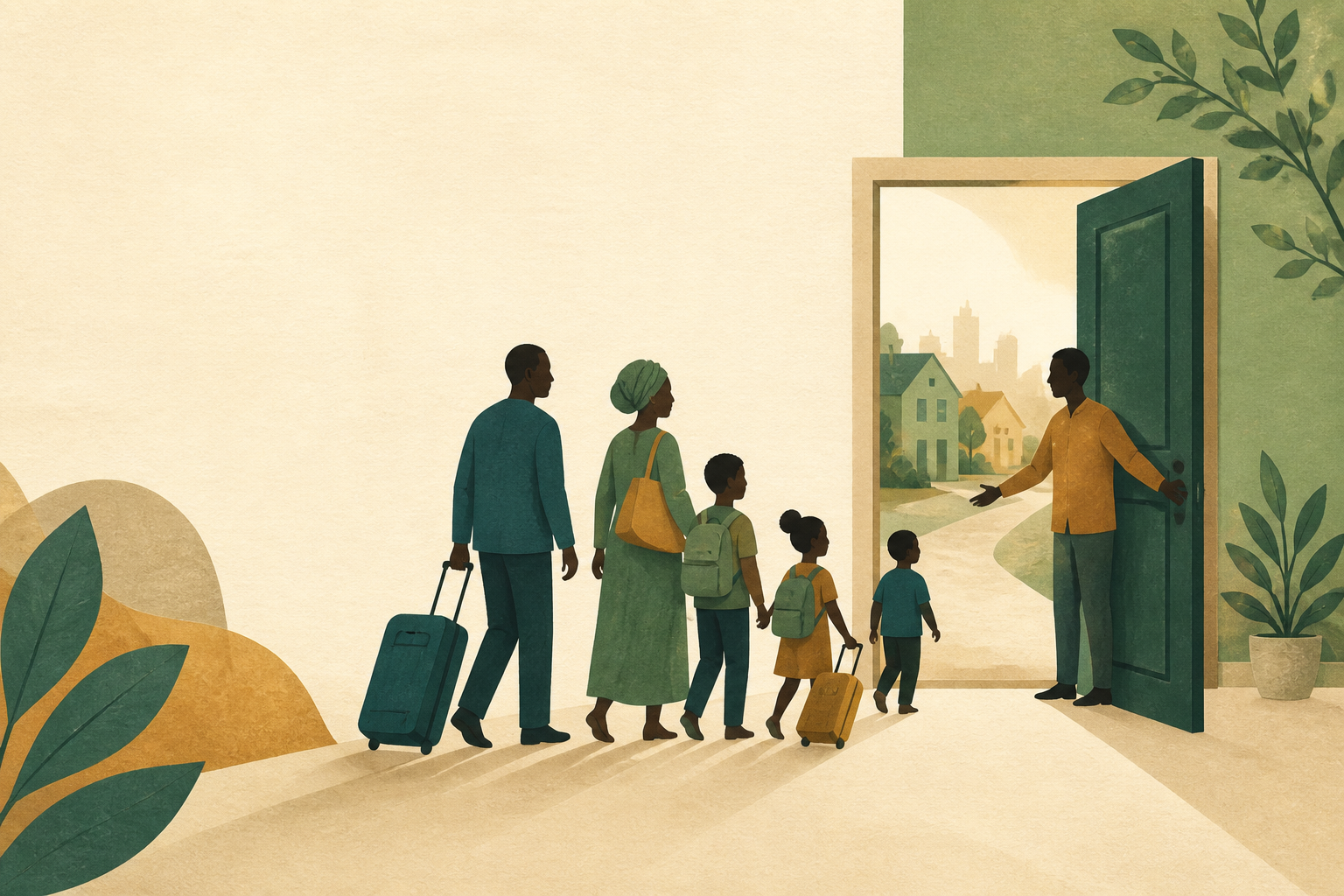
“Are you here to play, or are you here to stay?”
I was excited to reconnect with a former colleague from MTN in Lagos. I had moved to the United States with my wife and three children, and hearing a familiar voice felt good. Then he asked that question.
He meant: was I visiting, or had I moved permanently?
I said I was here to stay. The conversation went flat. We never really spoke again.
When somebody else later asked essentially the same question, and a similar distance followed my answer, I began to wonder what I was missing. Was a visitor easier to welcome than a person trying to build a life here? What changed when I said I was staying?
I cannot answer for those people. But the experience left me with a question that has lasted longer than the conversations: how do we turn the success Nigerians achieve abroad into something that makes the next Nigerian's arrival easier?
Starting again in Newark
Moving from Lagos took money, planning and a great deal of effort. I was coming with a family, and I needed the money I had saved to last. Choosing somewhere affordable was one of the first serious decisions I had to make.
I settled on Newark, New Jersey. I knew very little about the area. I understood the rent much better than I understood the local geography, the schools or the reputations attached to different neighborhoods.
A friend I had known in Lagos lived in New Jersey. We had done business together before going our separate ways commercially. I had tried to keep the friendship cordial because I never believed that ending a business arrangement should automatically end a human relationship. I had even used his address during parts of my immigration process.
After a difficult journey, we arrived well after midnight. He came the next day, took us to his place, helped us get American phone numbers and offered a few tips. Those things mattered. When you have barely spent a day in a country, getting your phone working is a meaningful piece of progress.
But he was alarmed that we were staying in Newark. He spoke about crime and shootings, and made it clear that he would not be coming there again.
He did not. Over time, the friendship faded too.
About two and a half years later, my experience of living here has been much less frightening than the picture he painted. I have met decent people and had good neighbors. The school options initially worried us, but we were fortunate to find charter schools that worked for our children.
That does not make my experience a safety assessment of an entire city, or a judgment on every school. It taught me something more practical: a place needs to be understood in detail. A warning is more useful when it helps you make a better decision. Which neighborhood? Which school? What alternatives can a family actually afford?
I was less interested in being angry with my friend than in understanding what had happened. The help at the beginning was real. So was the distance afterward. I kept turning that combination over in my mind.
A few encounters are not an entire community
After the other conversations, I began speaking with Nigerian immigrants about their own experiences. Some described a familiar feeling: people they expected to help them find their feet had become difficult to reach.
It would be easy to turn those stories into “Nigerians do not help Nigerians.” It would also be unfair. The people I spoke with were not a representative sample, and silence does not tell us why somebody withdrew.
A person who has been in America for years may still be struggling. They may be stretched by work, children, bills or responsibilities back home. They may have had a difficult experience helping someone before. Perhaps they hear “I have moved here” and anticipate obligations they cannot carry. Those are possibilities, not explanations I can assign to my former friends.
There are also Nigerians who welcome newcomers, share contacts and make room for people finding their way. Our professional groups, religious communities and hometown associations deserve acknowledgment. Rachel Reynolds's research on Igbo hometown associations in the United States documents people actively constructing communities abroad. The idea that we simply do not organize cannot carry this argument. [1]
The question I want to ask is more specific: how easy is it for a newly arrived person to reach the practical knowledge those communities hold?
You can know that an association exists without knowing whom to call about your first job search. You can attend a celebration and still go home confused about the decisions facing your family. Belonging and practical support can reinforce each other, but one does not automatically produce the other.
The knowledge nobody remembers learning
Arriving in a new country as an adult means becoming a beginner in areas where you are used to being competent.
You may have managed people, raised children and built a career. Then you find yourself trying to understand an unfamiliar credit system, a school application or a health insurance document. Ordinary decisions take longer because you do not yet know which details matter.
People who grew up inside the system have had years to absorb that context. A newcomer has to acquire it while paying bills and making decisions that cannot all wait until they feel ready.
That is why an experienced immigrant's knowledge can be so valuable. Sometimes the help you need is a conversation with someone who can explain what to investigate, direct you to a reliable source or tell you which questions to ask a qualified professional.
“Here is what I wish I had understood before I signed my first lease.”
That sentence can be useful without coming with a loan, a spare bedroom or a promise of employment. Someone can have firm boundaries and still be generous with information.
It would have helped me to hear a grounded explanation of the area I was moving into, including what was realistic within my budget. Fear alone gave me very little to work with. Experience translated into options would have given me something I could use.
For me, that is the everyday meaning of social capital: relationships that help useful knowledge and opportunity reach someone who would otherwise struggle to find them.
What competition carries across the ocean
I also wonder how much of our relationship with success travels with us.
Growing up and working in Nigeria, I became familiar with the comparisons. Houses, cars, schools, titles. Who was doing better? Who had moved ahead? Sometimes you could feel that calculation beneath an otherwise ordinary conversation.
This is not uniquely Nigerian, and it does not describe every Nigerian relationship. But it is a habit I recognize. Moving countries does not necessarily remove it.
If another person's progress feels like a judgment on your own, helping them can become emotionally complicated. An introduction that costs little starts to feel like giving away an advantage. A new arrival becomes somebody to measure yourself against before they have even found their feet.
I do not know whether that explains any of my experiences. I do think it is worth examining in ourselves. Can I share something useful without first calculating whether the person might eventually do better than me?
There are real limits to time and opportunity. Nobody can recommend every applicant or support every business. But passing on knowledge often leaves you with as much as you had before, and a stronger relationship besides.
Make the welcome easier to find
I would like our community organizations to treat helping newcomers understand their surroundings as a regular part of their work.
A hometown association or alumni group could offer a monthly conversation for recent arrivals. Members could share a short local guide with current links to school enrollment information, employment resources and public services. Someone would need to keep it updated, because advice that worked years ago can mislead a family today.
The guide would not need to pretend to answer everything. Its value would be in helping people find the right next step. A trusted referral, with any personal or commercial connection disclosed, is more useful than confident advice from someone outside their expertise.
A volunteer could offer an hour rather than an indefinite commitment. A professional could review a résumé without promising a job. A family could explain how they researched schools without claiming that the same choice would suit everyone.
Boundaries make this kind of help easier to sustain. Newcomers have responsibilities too: prepare questions, respect people's time, follow through and accept that a refusal is sometimes simply a limit. Sharing a nationality does not give us unlimited access to another person's resources.
Over time, I would want a group to ask whether its work is actually useful. Did someone find the information they needed? Did a referral lead somewhere? What confused this month's arrivals that the next group should hear about sooner?
Those answers could help individual experience become a resource that survives beyond one generous person. The newcomer who learns something can add to it. The person who settles can help the next arrival.
Integration without abandonment
I want Nigerians to build relationships widely in America. We should learn from people with different backgrounds, participate in local life and become comfortable working within the institutions of our adopted country.
A community that discourages those connections would limit the people it intends to help. Advice also needs room for disagreement. Being Nigerian does not automatically make someone the right accountant, employer, mentor or business partner for another Nigerian.
Still, I see no reason why becoming fully at home in America should require becoming less available to people from home. A useful community helps you understand the wider society and find your place within it.
Perhaps we need to become as intentional about building successful Nigerian communities abroad as we are about building successful individual lives. That is a question about what we do with our experience once we have acquired it.
I arrived with my wife and three children trying to make careful decisions in a place I barely understood. What stays with me is how much a little practical guidance could mean at that stage. I want to remember that feeling as the unfamiliar becomes ordinary to me.
“Are you here to play, or are you here to stay?”
I was here to stay.
The response I would like us to make more common is simple: “Welcome. What do you need to know?”
And once we have found our feet, there is another question worth asking ourselves: “Who am I helping next?”
Further reading
[1] Rachel Reynolds, “Igbo professional migratory orders, hometown associations and ethnicity in the USA,” Global Networks, 2009. https://doi.org/10.1111/j.1471-0374.2009.00251.x