
The Middle Is the Work
Starting is visible and finishing is celebrated, but the long, uncertain middle is where the product, company, and builder actually become durable.

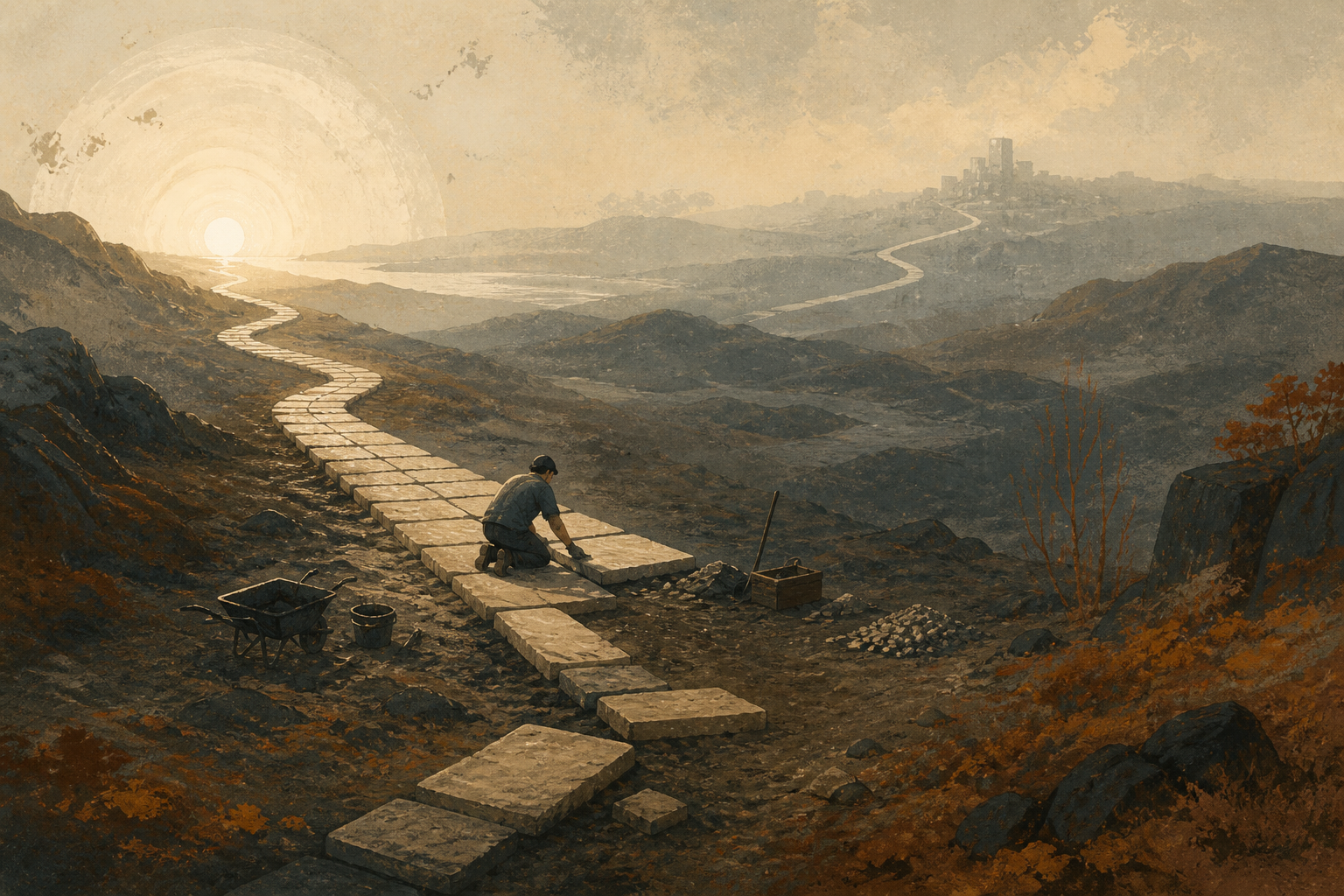
Starting is visible. Finishing is celebrated. The middle is where most of the company is actually built.
The middle arrives after the energy of the beginning, before the evidence of the outcome, and often before anyone outside the company has a reason to care. It is a long period of partial answers. The product works, but not reliably enough. Customers see value, but not always quickly enough. Growth appears, disappears, and returns in a different form. Every improvement reveals another layer that was previously hidden.
This is not an interruption to the build. This is the build.
The beginning gives you borrowed energy
At the beginning, possibility does some of the work. The product can still become almost anything. Plans are clean because reality has not yet argued with them. A new name, prototype, customer, or launch creates momentum that feels self-sustaining.
Then the company acquires weight.
Customers depend on decisions that were once provisional. The first architecture becomes infrastructure. A pricing experiment becomes an expectation. Support, billing, publishing, reliability, and communication begin to compete for the same attention. Progress no longer looks like adding one more feature. It looks like preserving what works while changing what no longer does.
The work becomes less dramatic and more consequential.
The middle replaces imagination with evidence
A founder can imagine a product perfectly. Customers encounter it specifically.
They do not experience the roadmap. They experience the missing button, the delayed response, the confusing label, the failed connection, and the moment the product either helps or does not.
This can feel discouraging because evidence is narrower than ambition. But evidence is also more useful. The middle teaches through friction:
- where the product promise is unclear;
- which customers are receiving real value;
- which features create a system and which create maintenance;
- where the founder is still the hidden process; and
- which problems repeat often enough to deserve structural attention.
The company becomes real by losing some of its imagined perfection.
Progress changes shape
Early progress is easy to narrate: first version, first user, first payment, first hire. Middle progress is harder to explain.
It may be a deployment that no longer requires fear. A support question that stops appearing. A new teammate who can make a decision without waiting. A queue that remains bounded under load. A customer who reaches value without a founder guiding every step.
These improvements rarely produce a dramatic announcement, but they increase the company’s capacity to survive success.
The middle is full of work that becomes visible only when it is missing.
Endurance is not endless force
Founder endurance is often described as the ability to keep pushing. That definition is incomplete. If the only operating mode is force, the system eventually consumes the person supplying it.
Endurance requires changing how the work is carried:
- turning repeated judgment into principles;
- turning repeated tasks into systems;
- turning private context into shared documentation;
- turning every interruption into a clearer boundary; and
- turning recovery into part of the operating model rather than a reward after collapse.
The goal is not to prove that you can personally absorb unlimited complexity. The goal is to build something that gradually requires less invisible heroism.
Uncertainty does not mean nothing is working
There are long periods when the signals disagree. Revenue improves while growth slows. Usage rises while satisfaction becomes noisier. A new capability attracts attention but creates operational strain. One customer segment expands while another becomes less suitable.
The temptation is to demand one clean verdict: working or failing, right or wrong, persist or quit.
Companies rarely provide that clarity on schedule. The better question is whether you are learning at a rate that changes the quality of your decisions.
Persistence without learning becomes repetition. Change without memory becomes thrashing. The middle requires enough patience to observe a pattern and enough honesty to change when the pattern becomes clear.
The work is allowed to be ordinary
Not every day of a meaningful build feels meaningful.
Some days are spent tracing a failure, rewriting a page, answering the same question with more patience, reconciling a bill, removing a feature, or discovering that a week of work solved the wrong problem.
The ordinary days are not evidence that ambition has disappeared. They are how ambition becomes operational.
A company is not built from peak motivation. It is built from the ability to return to the problem with enough attention to see it more accurately than before.
The middle has its own milestones
Waiting for the final outcome makes the middle feel endless. Create milestones that reflect maturity:
- a customer reaches value without founder intervention;
- a recurring failure is eliminated rather than patched;
- a difficult decision becomes easier because the principle is documented;
- the team detects a problem before a customer reports it;
- the company says no to work that does not strengthen its direction; or
- the founder can step away from one system without it becoming unsafe.
These are not consolation prizes. They are evidence that the product and the organization are becoming capable of carrying more weight.
The long build
The story told later will compress the middle. It will turn years into a paragraph and uncertainty into a sequence that appears intentional. The people living through it do not receive that version.
They receive today’s incomplete product, today’s customer, today’s constraint, and today’s decision.
The middle asks for a different kind of faith—not certainty that the outcome will arrive, but commitment to doing the next piece of work in a way that makes the company more truthful, useful, and durable.
The middle is not the distance between the important moments.
The middle is the work.
Follow GrowthDiary for more essays from the world of The Long Build.
Follow via RSS: latest articles · full article archive