
The Long-Form Turn on X Is Not a Gimmick, and the Way People Read Online Is Quietly Changing

For a long time, the dominant narrative around X was that it functioned almost exclusively as a high-velocity surface, a place designed for fast reactions, compressed opinions, and constant refresh rather than sustained attention or genuine reading, and that any attempt to introduce long-form writing into such an environment was either naive or destined to fail.
That narrative made sense in an earlier phase of the platform’s life.
It makes considerably less sense now.
In 2026, X is not subtly nudging creators toward long-form content but explicitly redesigning incentives around it, prioritizing Articles within ranking systems, tying creator payouts more closely to time spent by verified users, and attaching meaningful rewards to original writing that shapes conversation rather than merely reacting to it.
What is striking is not that the platform is doing this, but that user behavior, often assumed to be fixed or deteriorating, is adapting in ways that contradict the most cynical assumptions about online attention.
People are not suddenly reading everything.
They are, however, reading far more selectively, and when they decide that something is worth their time, they are willing to stay with it longer than critics expect.
The Question That Keeps Surfacing, and Why It Is Usually Asked the Wrong Way
The most common challenge to long-form on X is framed as a simple question: do people actually read these Articles, or do they scroll past them the same way they scroll past everything else?
The problem with that framing is that it treats reading as a binary outcome, either total commitment or total indifference, when in reality reading online has always been probabilistic, selective, and conditional on perceived value.
Most users do not read most Articles, just as most readers of newspapers never read every column or every feature in full.
What has changed is not the existence of skimming, but the way platforms now interpret and reward commitment when it does occur.
X no longer treats attention as interchangeable, and that shift has meaningful consequences.
What the Platform Is Actually Optimizing For
X's creator revenue sharing program officially ties payouts to Verified Home Timeline impressions - real views from Premium subscribers seeing content in their main Home feed (either "For You" or "Following"). This shift, announced in January 2026, moves away from previous models that included impressions in replies, which no longer count toward earnings. Instead, the focus is on organic visibility in timelines, with impressions from higher-tier Premium+ users weighted more heavily, and longer formats, such as Articles, receiving additional multipliers to encourage high-effort content.
While raw impressions drive monetization, the underlying algorithm prioritizes signals of sustained user interest to determine what appears in those timelines. These include dwell time (how long users linger on content), pauses during scrolling, bookmarks, saves, and return visits hours or days later. Early engagement in the first minutes also plays a key role in momentum, helping content gain broader distribution. Long-form content doesn't automatically succeed, but when executed well, it naturally aligns with these signals by encouraging deeper interaction, indirectly boosting timeline impressions and payouts. This structure rewards authentic resonance over artificial boosts, with the doubled revenue pool from 2025 Premium growth unlocking higher potential earnings for qualifying creators.
Chart 1: Estimated Average Time Spent per Content Format
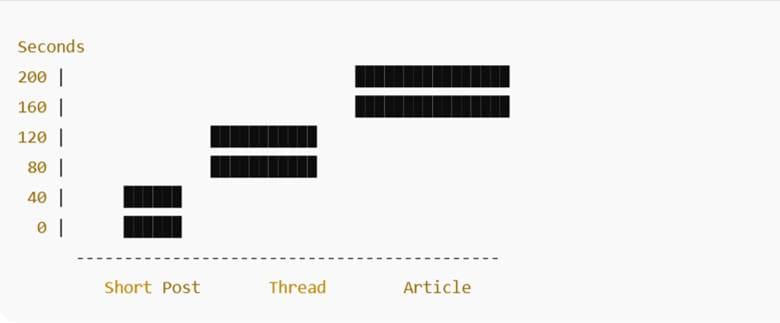
Based on aggregated creator analytics, platform disclosures, and third-party observation tools, typical ranges fall roughly into the following bands: short posts often hold attention for only a few seconds, threads can sustain engagement for half a minute or slightly longer, while Articles that resonate commonly hold readers for well over a minute and, in stronger cases, several minutes at a time.
The difference is not cosmetic. It compounds over repeated interactions.
How Reading on X Actually Happens in Practice
One reason long-form is often misunderstood is that it is imagined as a demand rather than an invitation, as though publishing an Article implies an expectation that readers owe it their full attention.
In practice, the opposite is true.
Reading on X is unforgiving, but also honest.
Most readers skim the opening paragraphs with intent, quickly assessing whether the piece signals originality, coherence, or insight, and they make a decision almost immediately about whether to continue, pause for later, or leave altogether.
When a piece fails to establish value early, readers exit without ceremony, and the platform registers that outcome just as clearly as it registers sustained engagement.
When a piece succeeds, however, the signals look very different.
Bookmarks rise faster than likes, replies reference specific arguments rather than headlines, and engagement unfolds over time rather than peaking all at once, with readers returning later to continue or to contribute to the discussion.
This pattern reflects discernment, not inattention.
Why Long-Form Is Gaining Ground Amid Short-Form Saturation
Short-form content still dominates volume on X, but dominance of volume does not imply dominance of influence.
The feed is now saturated with compressed opinions, repeated narratives, and increasingly polished but increasingly interchangeable summaries, many of which are optimized for speed rather than understanding.
Long-form writing offers a counterbalance by restoring context, continuity, and synthesis, allowing ideas to develop rather than compete for instantaneous reaction.
Readers who choose Articles are not necessarily rejecting short-form content. Still, they are seeking relief from the constant demand to react without thinking, and they are responding to writing that respects their capacity for sustained attention.
Threads fragment ideas across multiple posts. Articles consolidate them into a single cognitive space.
That distinction matters.
Chart 2: Engagement Characteristics by Format
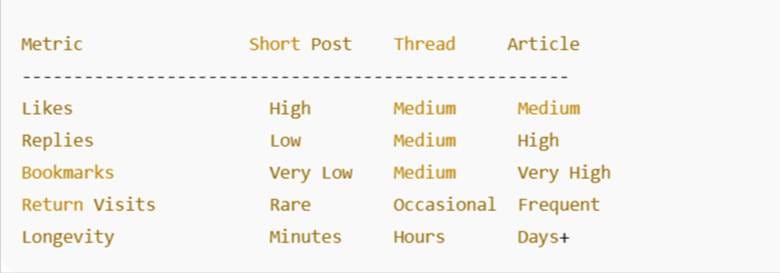
Surface-level engagement continues to favor short posts, but indicators of depth, memory, and return behavior consistently favor Articles.
The Question of AI, and Why It Cuts Both Ways
Concerns about AI-generated content are legitimate, particularly as long-form formats make it easier to produce large volumes of text quickly.
Yet the same tools that enable automation also raise reader expectations, making generic writing more visible and less tolerable.
Readers increasingly recognize human authorship through specificity, lived experience, timely references, and the organic evolution of ideas in replies and follow-up discussions, all of which remain difficult to simulate convincingly at scale.
X has reinforced this distinction by tightening originality requirements for incentive programs and competitions, placing greater emphasis on impact and authenticity rather than length or frequency alone.
In this environment, long-form does not protect weak writing; it exposes it.
Why Creators Are Investing in Depth Rather Than Frequency
The movement toward long-form among experienced creators is not driven by nostalgia or idealism but by pragmatic economics.
Time spent by verified users increases revenue sharing potential, sustained engagement strengthens subscription conversion, and demonstrated authority attracts higher-quality brand partnerships.
Chart 3: Approximate Creator Revenue Composition
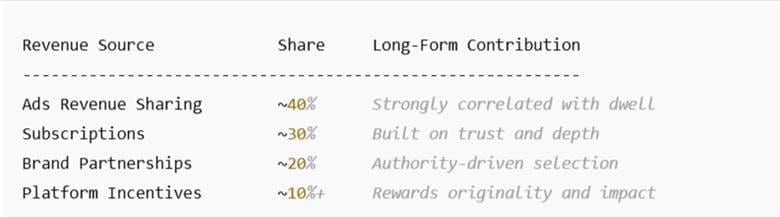
Long-form content functions as an anchor, converting fleeting attention into lasting relationships and shaping how a creator is perceived over time.
A More Honest Engagement Reality
Short posts remain effective for discovery, and threads continue to organize discussion efficiently.
Articles, however, serve a different role.
They establish intellectual gravity.
A well-received Article reshapes expectations, attracting readers who value depth and patience while discouraging those who do not, and in doing so, it improves the overall quality of engagement around a creator’s work.
This is why many high-performing accounts are not abandoning short-form content, but integrating long-form strategically, using it to define their perspective rather than to chase reach alone.
The question, then, is not whether long-form belongs on X, but whether what is being written deserves the attention it asks for.
X is not attempting to force long essays onto unwilling users, nor is it betting that attention spans have magically expanded.
Instead, it is recognizing that attention is unevenly distributed, and that the moments when readers choose to stay, reflect, and return are far more valuable than fleeting exposure.
Long-form on X is not about writing more words. It is about offering coherence in a fragmented environment and earning the reader’s time through clarity and originality.
People are reading.
They are simply far more selective than before, and far less forgiving of writing that fails to justify its own existence.