
SaaS Is a Long War

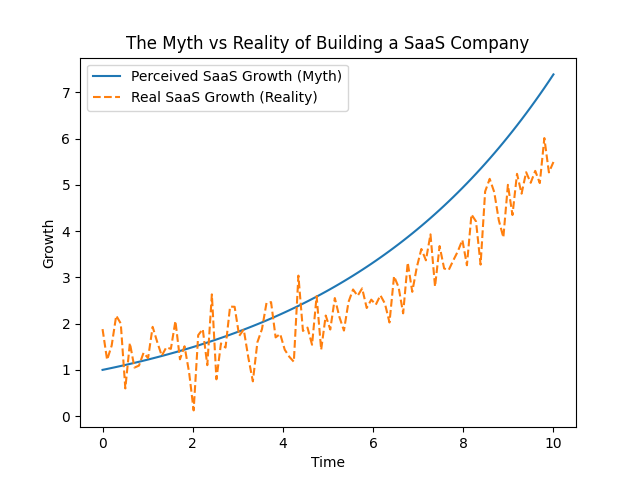
There is a version of the SaaS success story that gets told often, the one filled with smooth growth curves, viral adoption, and overnight traction. However, in reality, building a successful SaaS company is rarely a straight line; it is a prolonged, demanding journey defined by uncertainty, resilience, and a constant negotiation between belief and doubt.
For most founders, the truth is far less glamorous: progress is slow, the feedback is often silent, and the wins, when they come, are hard-earned and sometimes delayed by years.
The Reality: It Takes Longer Than You Think
Building a SaaS company takes time, far more time than you initially expect and within that time, you must be prepared for prolonged periods where nothing seems to work.
There are stretches where revenue stagnates, where users do not respond, where launches fall flat, and where the only thing that continues to move forward is your own commitment to showing up daily.
I have lived through this reality for over four years navigating the highs of early traction, particularly through lifetime deals that brought in initial capital, and the inevitable lows that followed when that capital began to dry up, consumed by development costs, infrastructure, and the ongoing burden of supporting those early users.
There were moments marked by repeated “insufficient funds” alerts, moments that force you to confront not just the viability of your business, but your own emotional endurance as a founder.
And yet, the work must continue.
The Discipline of Showing Up
What sustains you through these phases is not immediate success, nor external validation, but a deeper internal metric: the knowledge that you showed up and did meaningful work.
At the end of many days, there is no applause, no spike in revenue, no flood of positive feedback, only the quiet satisfaction that the product is slightly better than it was yesterday.
Over time, this discipline compounds, and the product matures. Then, almost unexpectedly, things begin to shift for the better.
The Turning Point: When Signals Start to Emerge
There comes a stage, and it is never exactly predictable, where usage begins to improve, where feedback starts to arrive without being forced, and where users begin to engage in ways that signal genuine value.
One of the most telling moments in this journey is when communication with users transitions from silence to response, when emails that once felt like they disappeared into a void suddenly start generating replies.
For the first time in a long time, users are not just passively existing within the product; they are actively engaging with it.
This is not luck, rather It is the delayed result of sustained effort.
Bootstrapping vs. Venture Capital: The Hidden Advantage of Patience
One of the most important realizations in this journey is understanding the structural advantage of bootstrapping, particularly in the early stages of building a product that requires time to mature.
Had external funding, whether venture capital or even angel investment, been introduced too early in Postly, the outcome could have been very different.
Investors, by necessity, operate within timelines and expectations that are often incompatible with the slow, nonlinear nature of product discovery and refinement.
The pressure to grow quickly, to demonstrate immediate traction, or to pivot prematurely can undermine the very process required to build something truly valuable.
Bootstrapping, while financially challenging, provides a critical advantage: Time.
- Time to iterate.
- Time to fail quietly.
- Time to understand the problem deeply enough to build the right solution.
Building a Company is Warfare
At its core, building a business is not a passive endeavor, it is a form of strategic warfare.
As the founder, you are the Field Marshal, responsible for navigating a constantly shifting battlefield where multiple forces must be managed simultaneously.
Your competitors are obvious adversaries, they challenge your positioning, your differentiation, and your ability to stand out in an increasingly crowded market.
But equally complex are your customers.
Customers do not always know what they want, and if you rely solely on reactive development, you risk building a product that is perpetually behind.
Instead, your role is to lead, to anticipate needs, to innovate ahead of demand, and to shape the direction of the product in ways that customers will only fully appreciate in hindsight.
This requires conviction.
It also requires an unwavering commitment to customer support, not as an afterthought, but as a core function of the business.
Support is where trust is built.
It is where long-term loyalty is formed.
And over time, it becomes a powerful differentiator.
The Product Evolution Cycle
Every successful product moves through a series of stages:
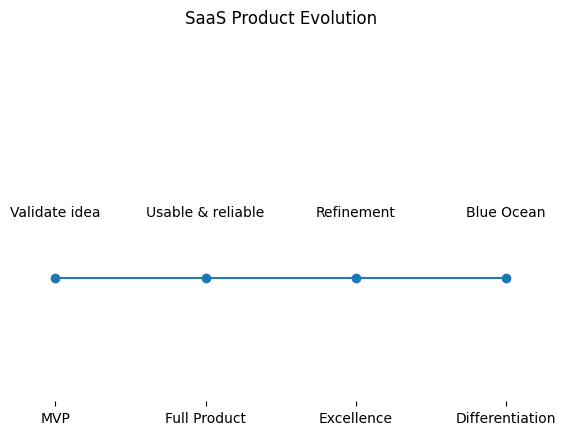
The MVP is about proving that the core idea has merit.
The full product expands that idea into something usable and reliable.
Product excellence focuses on refinement, performance, and experience.
But the most critical stage and often the most difficult is differentiation.
This is where you move beyond competing within an existing category and begin to redefine the space itself.
This is the transition from the “Red Ocean” where competition is intense and margins are compressed, to the “Blue Ocean,” where you create new demand and operate with far greater strategic freedom.
Here is the fully rewritten “Finding the Blue Ocean” section with your added context, written in long, natural sentences and keeping the narrative cohesive and founder-driven:
Finding the Blue Ocean
Innovation is not optional, it is survival, and more often than not, the path toward your next meaningful breakthrough does not reveal itself as a completely new idea, but as a deeper understanding of the space you are already operating in and the realization that you can extend beyond it in a way that changes the game entirely.
Postly Social, at its core, has always been an outbound tool, a system designed to help users promote, distribute, and amplify their message in order to attract leads and grow, and in the world of business, outbound tools are not just another category, they sit at the center of one of the hardest and most valuable problems to solve, which is customer acquisition.
And because they solve such a critical problem, they are also some of the hardest products to build and maintain, with constant technical challenges, evolving platform dependencies, and relentless competition from dozens of other tools trying to do the same thing, often with significant resources behind them.
This naturally places you in a red ocean, where differentiation is difficult, expectations are high, and the pressure to continuously deliver is constant.
Even more intimidating is the adjacent space of email marketing, which is arguably an even more competitive and mature domain, dominated by large, established players who have built deep ecosystems over many years, and it has always been a space I observed with a certain level of admiration and curiosity, because while it is crowded, it also represents one of the most direct and effective channels for outbound communication.
For a long time, the idea of entering that space felt distant, almost out of reach, not because the opportunity was not clear, but because the product itself was not yet ready to support that kind of expansion.
Nearly two years ago, a version of this idea surfaced through user feedback, but at that time, when the product was still struggling with stability and consistency, the reaction was immediate and strongly negative, with users pushing back and insisting that the focus should remain entirely on fixing and improving the core social media publishing experience.
At that stage, that feedback was not only understandable, it was necessary, because the foundation was not strong enough, and any attempt to expand into new territory would have likely created more problems than value.
So the idea was set aside, not rejected, but deferred until the product could reach a level of maturity that justified revisiting it.
Over time, through consistent effort and daily iteration, the product stabilized, eventually reaching a 99.9% success rate in publishing, and while that may appear to be a simple performance metric, what it truly represents is a shift in trust, where users no longer question whether the system will work, but instead begin to rely on it as part of their workflow.
This shift became visible in subtle but powerful ways, support requests dropped significantly, usage increased steadily as seen directly from the data, and the usual friction, complaints, and uncertainty that once defined the experience began to disappear.
In their place came a different kind of signal, one that is easy to overlook if you are not paying attention, a quiet satisfaction among users, reflected in unsolicited five star reviews, genuine testimonials, and a noticeable increase in patience and engagement even when issues did arise.
Users began testing the API, committing to yearly plans upfront, and even when they encountered problems that were clearly on our side, including mistakes in implementation and gaps in documentation, they stayed engaged, worked through the issues with us, and demonstrated a level of trust that only exists when the core product is fundamentally strong.
It is at this point, when stability has been earned and trust has been established, that a founder must begin to look beyond the immediate competitive space and start identifying where the next opportunity lies.
Because it is not always about inventing something entirely new from scratch, but about recognizing the moment when you can step beyond the crowded space you have been competing in and begin to expand into areas where competition is minimal and differentiation becomes natural.
This is where the idea of Send to Email returns, but now under completely different conditions.
The intention behind it is not to compete directly with the giants of email marketing, but to carefully and strategically carve out a position within that space by leveraging what Postly already does well.
Instead of building a full email marketing platform from scratch, the approach is to connect with the leading players in that ecosystem and enable Postly users to take the same content they are already creating for social media and extend it seamlessly into email campaigns.
In doing so, Postly evolves from being just a social publishing tool into a more complete outbound system, one that allows users to reach their audience across multiple channels without duplicating effort or switching contexts.
This is where the Blue Ocean begins to take shape.
It is not competing head-on with established email platforms, but in creating a bridge between social content and email distribution, a space that is far less saturated and far more aligned with how modern teams actually operate.
And the timing of this matters.
An idea that was once rejected when the product was unstable is now being received with interest and engagement, not because the idea itself has changed, but because the product has evolved to a point where it can support it effectively.
This is the essence of finding a Blue Ocean, recognizing when everything you have been building has positioned you to move beyond competition and into creation.
The signals are already there, stronger engagement, real user trust, meaningful feedback, and a growing sense that the product is no longer fighting to survive, but is ready to expand into something greater.
And in moments like this, hesitation becomes the biggest risk.
Because when you begin to see the outline of a new space, you do not wait for perfect validation, you move with conviction, you build, you refine, and you expand, taking full advantage of being early, because in the end, the real advantage is not just in identifying the opportunity, but in acting on it before the rest of the market catches up.
Conclusion: The Only Way Forward Is Through
The journey of building a SaaS company is not defined by a single breakthrough moment, but by a long sequence of small, often invisible improvements that compound over time until they begin to change the nature of the product itself.
It is defined by persistence in the absence of validation, by continuing to build when feedback is silent or negative, and by holding conviction during phases where nothing externally suggests that you are on the right path.
It is also defined by timing, because ideas that are rejected at one stage of the journey can become the very opportunities that unlock growth at a later stage, not because the ideas themselves have changed, but because the product and its foundation have evolved enough to support them.
There are long periods where the focus must remain narrow, where survival depends on fixing what is broken, stabilizing the core, and earning the trust of users through consistency and reliability, and it is only after this foundation is firmly established that expansion begins to make sense.
When that moment arrives, it does not come with noise or celebration, but with subtle signals, reduced friction, increased usage, patient users, and a quiet confidence that the product is finally ready to move beyond its initial boundaries.
This is where the shift happens, from fighting within a crowded and competitive space to recognizing opportunities to create something that stands apart, to move from competing in a red ocean to carefully stepping into a blue one.
And this shift is not automatic, it requires awareness, it requires courage, and above all, it requires action.
Because when you begin to see that opportunity, hesitation becomes the greatest threat, and the advantage belongs not just to those who identify it, but to those who move on it while others are still trying to understand it.
In the end, things do get better, but not by chance and not by waiting, they get better because you stayed in the process long enough to reach the point where improvement compounds, trust builds, and new paths begin to reveal themselves.
And success, more often than not, does not belong to the fastest or the loudest, but to those who endure long enough to see the game change in their favor.