
Platform Leverage in the Fragmented Social Web: A Strategic Analysis of X, Threads, Bluesky, and Mastodon in the Era of Community-Driven Distribution

Abstract
As the social media ecosystem transitions from centralized dominance toward a fragmented yet structurally similar set of text-based platforms, the question facing modern operators is no longer one of participation, but of strategic concentration. This paper examines X, Threads, Bluesky, and Mastodon using publicly observable SEO and domain metrics - including organic traffic, keyword footprint, and backlink distribution - to understand where leverage is most efficiently created. By analyzing these platforms as interconnected layers of a shared conversational paradigm, this work proposes a framework for identifying where sustained effort yields disproportionate returns in reach, influence, and long-term compounding visibility.
Introduction: The Re-Centralization of Conversation Around Text
Despite the rise of video-first platforms and short-form content over the last decade, the current cycle of the social web is increasingly converging around text-based, thread-oriented, community-driven environments, where discourse is persistent, searchable, and layered over time rather than consumed and discarded.
What is particularly notable is that X, Threads, Bluesky, and Mastodon - while often positioned as competitors - are in fact variations of the same structural model: they prioritize public conversation, threaded interaction, and ambient community participation.
This convergence changes the nature of platform strategy.
The decision is no longer about format fit - since all four support similar modes of expression - but rather about:
where attention is concentrated, where influence is distributed, and where effort compounds most effectively over time.
Methodology: Using Discoverability as a Proxy for Platform Leverage
To move beyond subjective narratives about platform relevance, this analysis relies on domain-level metrics from SEMrush, including:
- Organic Traffic
- Organic Keywords
- Backlinks
- Referring Domains
- Authority Score
These indicators, while not a direct measure of in-app engagement, provide a powerful proxy for:
- discoverability
- network effects
- cultural embedment
- long-term visibility
Figure 1: Organic Traffic Distribution
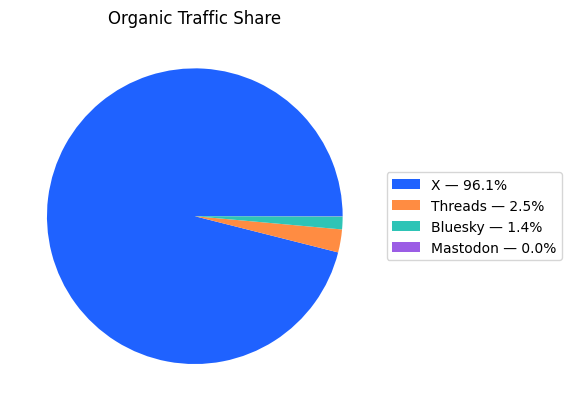
The distribution of organic traffic across the four platforms reveals an overwhelming concentration:
Traffic Data (Similarweb)
- X: ~198.9 million monthly visits - 96%
- Threads: ~5.2 million monthly visits - 2.5%
- Bluesky: ~2.9 million monthly visits - 1.4%
- Mastodon: ~59.3 thousand monthly visits - 0.0%
Interpretation
This level of dominance suggests that X is not simply another platform - it is still functioning as a core infrastructural layer of the public internet, particularly in how content is indexed, referenced, and surfaced through search.
From a leverage perspective, this means that:
- content created on X has higher probability of external discovery
- discussions are more likely to be referenced across media ecosystems
- participation contributes to broader visibility beyond the platform itself
Figure 2: Organic Keyword Footprint
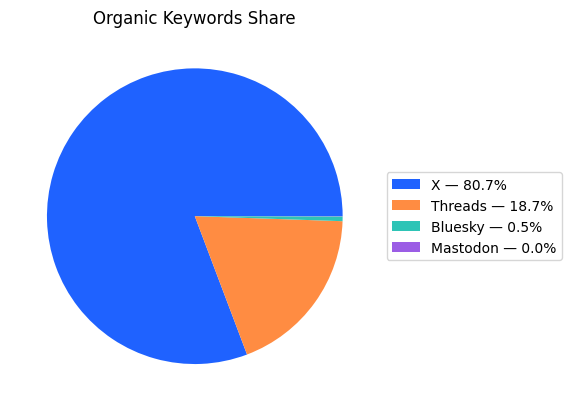
- X: ~46.6M keywords (~80.7%)
- Threads: ~10.8M (~18.7%)
- Bluesky: ~293.6K (~0.5%)
- Mastodon: ~17.3K (~0.03%)
Interpretation
While X still leads significantly, Threads demonstrates a meaningful presence in keyword coverage, suggesting institutional growth and search visibility, particularly as it integrates with Meta’s broader ecosystem.
Bluesky, by contrast, remains minimal in keyword footprint, indicating that its influence is not yet reflected in search-scale discoverability.
Figure 3: Backlink Distribution
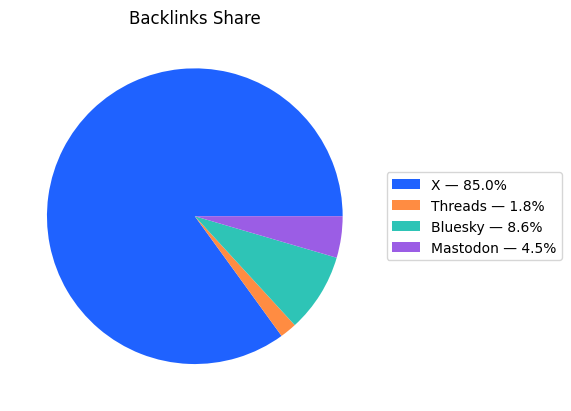
- X: ~9B backlinks (~85%)
- Bluesky: ~915.8M (~8.6%)
- Mastodon: ~480.1M (~4.5%)
- Threads: ~194.2M (~1.8%)
Interpretation
This is where the narrative becomes more nuanced.
Despite its smaller size, Bluesky’s backlink share is disproportionately high, which signals:
- strong attention from web-native communities
- high citation among early adopters
- growing relevance in discourse networks
This suggests that influence density, not just scale, is an important dimension of platform leverage.
Platform-Level Strategic Analysis
X: Maximum Reach, Maximum Velocity
X continues to dominate across all major visibility metrics, positioning it as the platform with the highest potential for:
- real-time amplification
- cross-platform visibility
- participation in high-velocity discourse
However, this comes with increased competition and shorter content lifespan.
Best suited for:
- thought leadership
- commentary on live events
- product announcements
- narrative shaping at scale
Threads: Accessible Scale and Mainstream Engagement
Threads represents a more controlled and consumer-friendly environment, with growing keyword presence and ecosystem support.
Its strength lies in:
- lower friction interaction
- broader audience accessibility
- alignment with lifestyle and creator content
Best suited for:
- brand storytelling
- audience nurturing
- creator-led campaigns
Bluesky: High Leverage Through Network Density
Bluesky’s most important characteristic is not its size, but its composition.
It attracts:
- technologists
- researchers
- journalists
- early adopters
This creates a platform where:
- ideas travel through high-value networks
- engagement is more intentional
- relationships compound over time
Best suited for:
- credibility building
- community-driven growth
- intellectual and technical discourse
Mastodon: Trust-Based, Values-Aligned Engagement
Mastodon operates outside the traditional growth paradigm, prioritizing decentralization and community governance.
Its leverage is not in reach, but in:
- trust
- alignment
- depth of engagement
Best suited for:
- open-source ecosystems
- privacy-focused audiences
- mission-driven organizations
Strategic Framework: Where Should You Focus?
The key principle emerging from this analysis is:
Growth is not about being everywhere - it is about being where effort compounds most efficiently.
A practical approach involves:
1. Identify Your Highest-Value Audience
Where are they most active - not just present?
2. Evaluate Network Density vs Scale
- X → scale and visibility
- Bluesky → influence concentration
- Threads → accessibility
- Mastodon → alignment
3. Optimize for Compounding
Choose the platform where your efforts:
- build recognition over time
- strengthen relationships
- increase marginal returns
The Role of Tooling in a Fragmented Ecosystem
As practitioners navigate multiple platforms, tools inevitably become part of the workflow, enabling consistency and cross-posting without excessive overhead.
Social media scheduling and management platforms such as , Buffer, Postly and Publer facilitate this process, but it is important to emphasize that tools do not create leverage - focus does.
The most effective operators are those who:
- establish dominance in one platform first
- understand its cultural dynamics
- and only then expand strategically
Broader Implication: The Rise of Community-Led Distribution
Across all four platforms, a common pattern emerges:
- distribution is increasingly community-driven
- authority is built through consistent participation
- influence is shaped by network proximity, not just scale
This represents a shift away from algorithm-driven virality toward:
- sustained engagement
- idea clarity
- relational credibility
Conclusion: Leverage Is a Function of Alignment and Focus
The fragmentation of the social web has not reduced opportunity - it has redistributed it.
Each platform represents a different form of leverage:
- X → reach and immediacy
- Threads → accessibility and warmth
- Bluesky → influence density
- Mastodon → trust and alignment
The strategic challenge is not to choose all of them, but to choose:
- the one where your audience already gathers,
- the one where your voice feels native,
- and the one where effort compounds over time.
Because in the modern social web, growth is no longer driven by presence alone -
it is driven by precision, consistency, and the ability to embed oneself within the right community long enough for influence to take hold.