
Nigeria: Population Without Prosperity, and the Cost of a Broken Economy
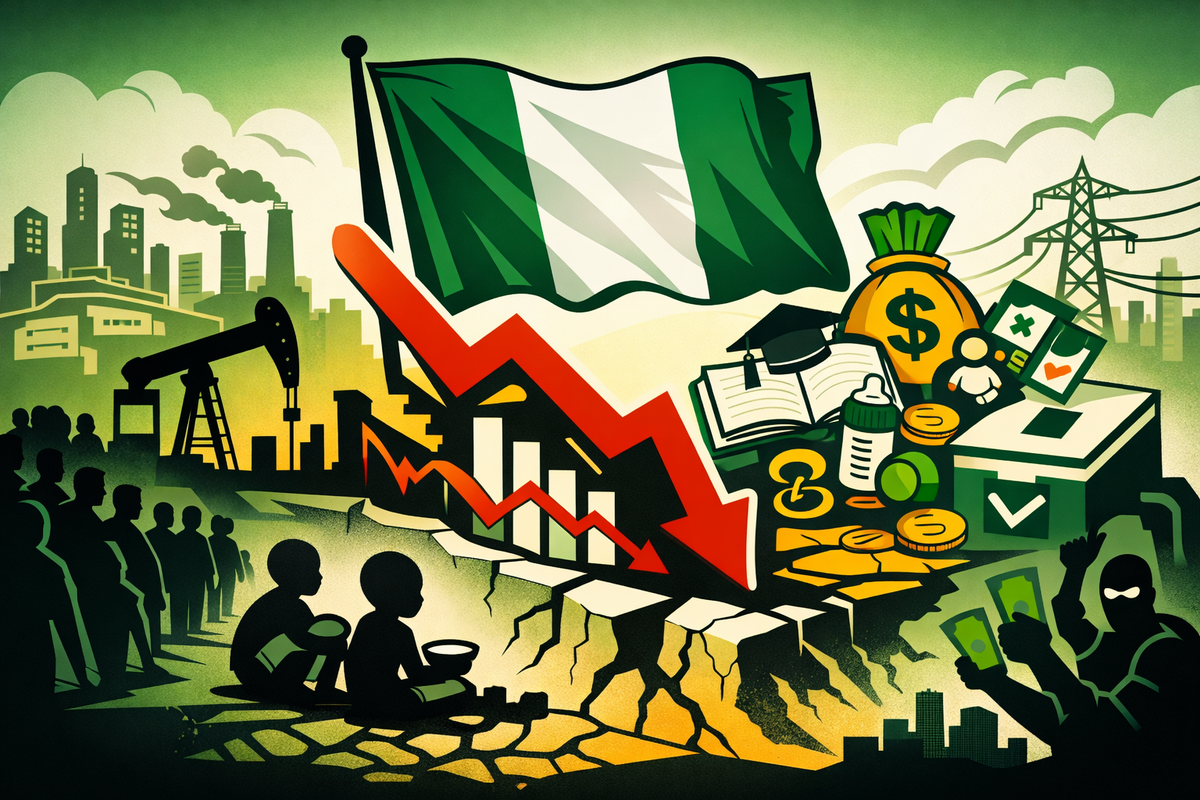
Nigeria is Africa’s most populous country, now exceeding 230 million people and growing at roughly 2 percent every year. In theory, this scale should be its greatest economic strength. Large populations, when matched with productivity and functioning institutions, fuel industry, innovation, and exports. In reality, Nigeria has become a cautionary tale of what happens when population growth outpaces economic structure, and governance collapses under its own weight.
Nigeria’s economy is often described as “large,” but that description obscures more than it explains. Total GDP measures the size of an economy in aggregate, not how well people live within it. A country can have a large GDP simply because it has many people. What matters more is GDP per capita, which divides total economic output by population and provides a clearer picture of productivity and living standards.
Nigeria’s nominal GDP is estimated between $360 and $400 billion. Spread across more than 230 million people, this translates to a GDP per capita of roughly $2,000 to $2,500. By comparison, Morocco and Egypt sit closer to $3,500 to $4,000. South Africa is around $6,000 to $7,000. Botswana exceeds $7,000, while Mauritius has crossed $10,000.
These gaps are not cosmetic. They represent fundamentally different economic realities and futures.
Source: World Bank World Development Indicators, IMF World Economic Outlook, UN National Accounts (2023–2025 estimates).
Even GDP per capita overstates how Nigerians actually live. Income distribution is extremely unequal. A small elite captures a disproportionate share of national income, while the majority live near subsistence. Multiple poverty assessments and household surveys suggest that tens of millions of Nigerians survive on the equivalent of $1 to $3 per day, roughly $30 to $90 per month. After food, transport, rent, and basic survival costs, disposable income for many households is effectively zero. Any shock—illness, fuel price increases, school fees, or rent hikes—pushes families into immediate distress.
Nigeria once had a fragile but visible middle class composed of civil servants, professionals, and small business owners. The middle class has largely collapsed. Inflation, currency depreciation, job insecurity, and stagnant wages have pushed many households downward. What remains is a thin upper tier, often earning in foreign currency or benefiting from political access, and a vast population living one step away from poverty. The erosion of the middle class weakens tax capacity, social stability, and democratic accountability. Societies without a middle class become polarized and easier to manipulate.
Poverty Is Not Neutral
Poverty is not merely an economic condition. It reshapes behavior, incentives, and social norms.
Persistent deprivation produces desperation. Desperation fuels crime, fraud, and informal survival strategies. Youth unemployment creates a large pool of idle energy that criminal networks and political actors readily exploit. Cyber fraud, street crime, political thuggery, militancy, and organized insecurity all thrive where legitimate economic paths are blocked. This is not a moral failure. It is a predictable outcome of structural neglect.
Poverty also becomes a political weapon. When people struggle to eat, small handouts can buy loyalty. Politicians exploit hardship to distribute cash, food, or favors during elections while manipulating voter registers, intimidating opponents, and hollowing out institutions. In such conditions, democracy exists in form but not in substance.
Population Growth: What Two Percent Really Means
Nigeria’s population growth rate of about 2 percent may sound modest, but at this scale it means roughly 4.5 to 5 million additional people every year. These are children who will need food, education, healthcare, housing, and eventually jobs. If the economy does not grow fast enough to absorb them productively, poverty deepens automatically. Growth becomes arithmetic rather than progress.
High fertility is closely linked to poverty and insecurity. Where education is weak, healthcare access is limited, and economic prospects are uncertain, families tend to have more children, not fewer. Children become both emotional anchors and informal insurance in the absence of functioning social safety nets.
Unemployment and idleness compound this dynamic. When young people lack jobs, structure, and opportunity, early and unplanned parenthood increases. Marriage is delayed or destabilized by economic stress, informal unions rise, and single-parent households become more common. This places disproportionate strain on women, weakens household stability, and worsens outcomes for children in education and health. These dynamics reinforce intergenerational poverty and social fragility.
Production and Exports: The Missing Foundation
At the core of Nigeria’s economic failure is production. Nigeria exports crude oil largely in raw form and imports refined fuel, machinery, and consumer goods. Manufacturing exports are minimal. Value addition is weak.
By contrast, Morocco exports automobiles, auto parts, aerospace components, fertilizers, and agricultural products. Egypt exports petrochemicals, food products, and textiles. South Africa exports vehicles, machinery, and processed minerals. Botswana managed its diamond sector with discipline and reinvested strategically. Mauritius built competitive niches in textiles, tourism, and financial services.
These countries did not wait for perfect politics. They built production capacity and export systems over time. Nigeria largely skipped this phase and became a consumption economy dependent on imports and volatile oil revenues.
Technology startups in Nigeria are impressive, particularly given the constraints under which they operate, but they cannot absorb a population of over 230 million. Tech employs too few people and depends heavily on foreign capital and platforms. No large country has ever industrialized on apps alone. Development requires electricity, manufacturing, logistics, and exports.
Can Nigerians Develop by Ignoring the State?
Many Nigerians have learned to survive despite the state by exporting services, building private infrastructure, or operating informally. This may work at the individual level, but it cannot work at scale.
Roads, ports, power grids, security, courts, and trade policy are public goods. Nigeria’s problem is not the existence of the state but its inefficiency, corruption, and predatory behavior at the federal, state, and local levels.
State and local governments are not innocent bystanders. Many function as consumption centers rather than development engines. Funds are allocated, spent, and rarely invested productively. Corruption and waste are entrenched across all tiers of government, and accountability is weak. Ignoring the state may help people cope, but it cannot lift millions out of poverty or stabilize the country.
2027: What Happens If Nothing Changes
The question many Nigerians are quietly asking is what happens if the political trajectory does not change by 2027. This is not speculation. It is a practical concern rooted in experience.
If elections remain uncompetitive, institutions continue to weaken, and economic policy stays erratic, the consequences will be concrete. Capital will keep leaving. Talent will continue to emigrate. Informality will deepen. Poverty will expand structurally, not temporarily.
In such a scenario, Nigerians cannot wait for electoral salvation alone. Development does not pause while politics stagnates. One response will be economic self-defense. Households and businesses will increasingly try to earn in foreign currency, export services or goods where possible, and build parallel infrastructure in power, water, and security. This may preserve individual livelihoods but will further fragment the economy and widen inequality.
Another response must be sustained civic pressure beyond election cycles. Accountability cannot be episodic. Media, professional associations, labor groups, civil society, and the diaspora must apply continuous scrutiny, tying legitimacy to measurable performance rather than party loyalty. This path is slow and imperfect, but it remains the only non-violent route to institutional recovery.
A third response is forced decentralization through competence rather than rhetoric. States that can manage power, security, and basic services will pull ahead. Others will stagnate. Over time, internal migration and capital flows will expose failures and reward competence, even in the absence of federal reform.
What must be avoided is despair. When citizens conclude that nothing can change, disengagement follows. Disengagement creates space for deeper manipulation, repression, and decline. Nigeria does not collapse overnight. It erodes. And erosion accelerates when survival becomes the ceiling of ambition.
Addressing the Predictable Pushback
Some will argue that Nigeria’s problems are entirely the legacy of colonialism. Colonialism left scars, but it does not explain why countries with fewer resources and smaller populations now outperform Nigeria. Post-independence choices matter.
Others will insist that technology will save Nigeria. Technology helps, but no country of Nigeria’s size has developed without manufacturing, energy, and exports. Tech is an accelerator, not a foundation.
Some will say the population itself is Nigeria’s strength. Population is only a strength when it is educated, employed, and productive. Otherwise, it magnifies poverty.
Finally, some will blame Nigerians themselves. This misses the point. Nigerians are among the most entrepreneurial people in the world. The failure lies in incentives, institutions, and governance, not in human potential.
The Central Truth
Nigeria’s problem is not population. It is a wasted population. A country this large should not be this poor. People this hardworking should not live this close to the edge.
Development is not mysterious. It is production, exports, functioning institutions, and time. Until Nigeria builds an economy that creates jobs and exports at scale, poverty will continue to feed political manipulation, and population growth will remain a burden rather than a blessing.
The question is no longer whether Nigeria has potential. It is whether it can summon the discipline and leadership to use it.